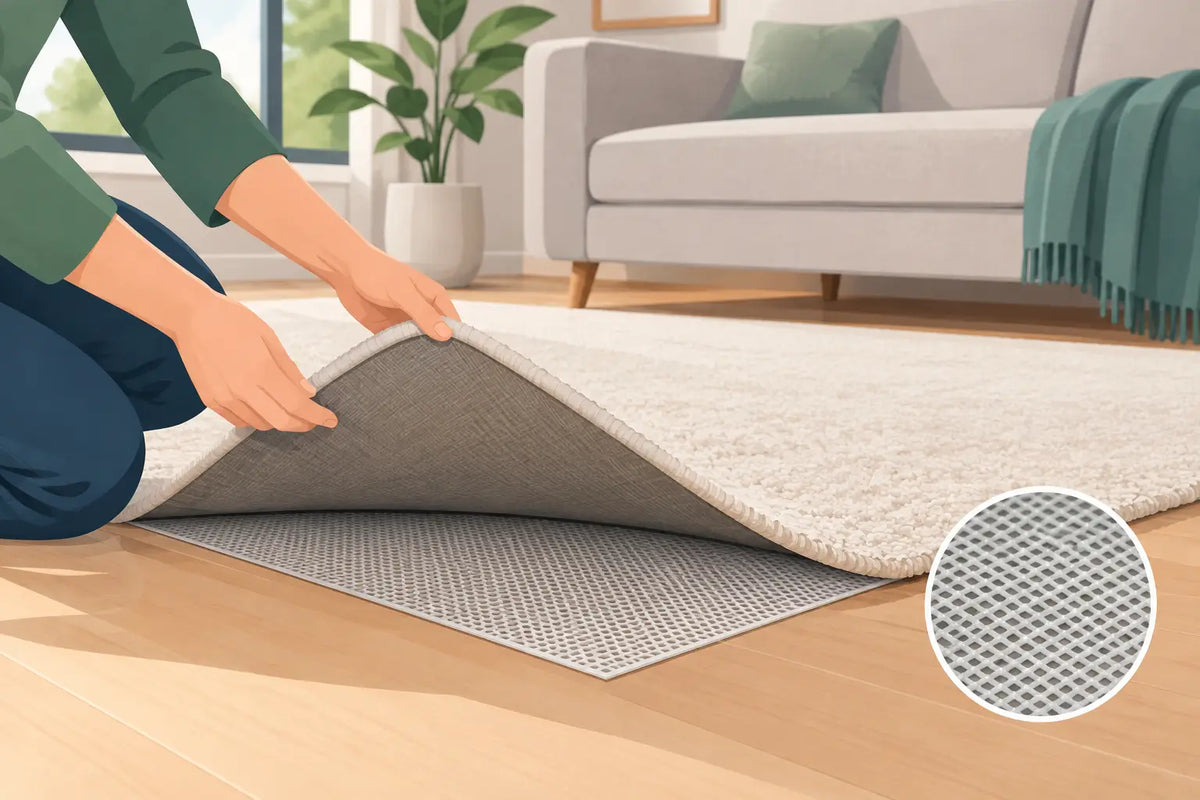
A beautiful rug that shifts a few centimeters every time someone walks by can quickly disrupt the calm in your interior. Especially in a busy household, with children at play or an enthusiastic dog, a rug that slips around is not only annoying but also less safe. Placing anti-slip under a rug is a small step that makes a big difference: your rug stays neatly in place, feels more comfortable, and protects your floor at the same time.
An anti-slip underlay is often invisible, but you notice its effect every day. The sitting area looks tidier, chairs slide around less at the dining table, and you don't have to keep straightening the corners of your rug. The secret is mainly choosing the right underlay and applying it correctly.
Why placing anti-slip under a rug makes such a big difference
A rug does not lie equally securely on every surface. On smooth floors such as parquet, laminate, vinyl, tiles, and natural stone, even a heavy rug can slowly shift. This can happen due to walking, vacuuming, children playing, or moving furniture. You usually notice this sooner with a lightweight, low-pile rug than with a thick, heavy model, but larger rugs can also curl at the edges or shift.
A good anti-slip underlay creates grip between the floor and the rug. This helps the rug lie flatter and reduces the risk of tripping. That is especially useful in a hallway, living room, child's room, or under the dining table - places with lots of activity where comfort must go hand in hand with safety.
An underlay also provides light cushioning. Your rug feels fuller and more comfortable underfoot, while impact noise is softened somewhat. For certain rugs, the extra layer also helps reduce wear on the underside. That way, you can enjoy the color, texture, and warmth your rug brings to the room for longer.
Which anti-slip underlay is right for your floor?
The best choice depends on two things: your floor material and the type of rug on it. A standard anti-slip mat with an open plastic structure is a popular solution for many smooth, hard floors. You can easily cut it to size, and it immediately provides more grip. However, not every underlay is suitable for every floor, so always look beyond the price alone.
On parquet and wooden floors
A wooden floor deserves extra attention. Some anti-slip materials, especially when they lie under a rug for a long time, can cause discoloration or react with lacquer, oil, or varnish. So choose an underlay that is explicitly suitable for parquet and other delicate hard floors. A felt-like underlay with an anti-slip layer is often a great choice: it provides grip, offers a little extra protection, and feels luxurious under the rug.
Are you placing a rug on a recently treated wooden floor? Give the finish enough time to cure completely first. If in doubt, it's a good idea to test the underlay briefly in an inconspicuous spot.
On laminate, vinyl, and PVC
Laminate, vinyl, and PVC are practical flooring options found in many Belgian homes. They're usually smooth, which makes loose rugs more likely to move. A thin non-slip mat is often enough here, as long as it doesn't contain plasticizers that could damage your floor.
With PVC and vinyl, it's especially important to choose an underlay that's suitable for plastic flooring. The wrong combination can leave marks or cause discoloration over time. It's better to choose quality than to use a random mat you happen to have in storage.
On tile and natural stone
Non-slip pads generally work very well on tile and natural stone floors. However, take care with floors that have wide grout lines or a pronounced texture. A very thin underlay may not make even contact with the floor. A slightly thicker non-slip mat helps keep the rug flat and prevents the corners from curling up.
This is especially valuable in an entrance hall, where moisture, sand, and heavy foot traffic all come together. A rug that stays in place creates a warm welcome and makes the space more practical to use.
On carpet
If your rug is on wall-to-wall carpet, a traditional rubber non-slip mat isn't always the best solution. The rug is less likely to actually slide away, but it can still shift or wrinkle on the soft surface. A special carpet-to-carpet underlay, often with a grip texture on both sides, provides greater stability without damaging the carpet underneath.
How to place a non-slip rug pad in five easy steps
You don't need a toolbox or technical experience. Work carefully, and you'll get a neat result in just a few minutes.
1. Clean and dry the floor. Dust, grains of sand, and moisture reduce grip and can cause scratches under pressure. So vacuum both the floor and the underside of the rug.
2. Measure your rug. Measure its length and width accurately, especially if it has rounded corners or an unusual shape.
3. Cut the underlay slightly smaller. Leave about 5 to 10 centimeters of clearance on each side. This keeps the non-slip layer completely out of sight, even if the rug shifts a little or you look at it up close.
4. Lay the underlay flat. Make sure there are no folds, turned-up edges, or air bubbles. A crease in the underlay may show through your rug later and reduce comfort.
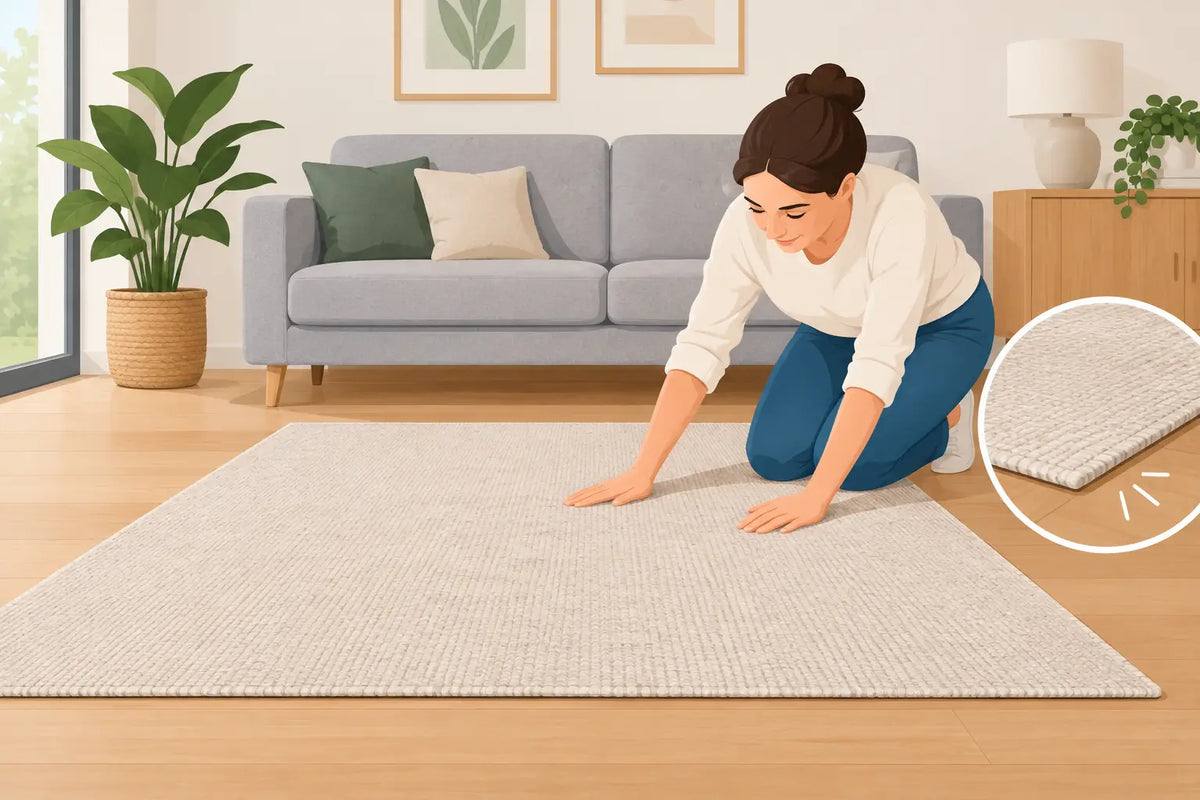
5. Carefully place the rug back. Start on one side and gradually lower the rug onto the underlay. Smooth it out with your hands, then walk around the edges to check that everything is stable.
For a large rug, such as one measuring 200 x 300 cm, it’s easiest to work with two people. This prevents the underlay from shifting as you lay the rug over it.
Should the underlay be the same size as the rug?
No, in most cases, slightly smaller is better. An underlay that reaches all the way to the edge may show or collect dust along the sides. It can also subtly lift the edge of a thin rug. Cutting the non-slip mat a few centimeters smaller helps the whole thing look neat and natural.
For a very small kitchen runner or bath mat, a smaller margin may be enough. For large living room rugs, the underlay can be generously sized, as long as it stays within the rug’s outline. The goal isn’t to cover every last millimeter, but to provide enough grip where it’s needed.
When don’t you need extra non-slip protection?
Some washable rugs and low-pile styles already have a non-slip backing. That’s especially convenient: just lay them down and enjoy greater stability right away. Check from time to time that the grip is still working well, especially after several washes or in high-traffic areas.
Some very heavy hand-knotted rugs stay firmly in place on their own, even on certain floors. Still, a suitable underlay can be useful for protecting the floor and providing extra cushioning. It depends on the combination of your rug, flooring, and household. You’ll often need less in a quiet bedroom than in a living room that gets used every day.
It’s best not to use double-sided tape as a permanent solution, especially on delicate flooring. Tape can leave adhesive residue, damage the floor’s finish, and make it harder to lift your rug for a thorough clean. A high-quality underlay is usually a better-looking, safer, and more durable choice.
Keep your rug and underlay fresh
Take up your rug from time to time to vacuum both the floor and the underlay. Dirt can build up unnoticed, especially if you have pets, a fireplace, or a busy entrance hall. If the underlay starts to lose its grip, check whether it’s dusty, worn, or dried out.
A good underlay doesn’t need much attention, but it does deserve a quick check when you clean your home. This helps keep your rug looking good and the floor underneath clean and hygienic.
A rug brings color, softness, and character to your home. With the right non-slip underlay, that warm look stays exactly where it belongs: firmly in place and ready for everyday life.


Leave a comment
This site is protected by hCaptcha and the hCaptcha Privacy Policy and Terms of Service apply.